

Strategic Planning When the World’s on Fire: How Vermont Foodbank Built Clarity Through Collaboration
A project led by Meredith Nguyen of Vim & Rigor & Meg Davidson Consulting
Why Strategic Planning Feels Broken Right Now (And Why It Doesn't Have To Be)
We hear it all the time: nonprofit leaders are exhausted by strategic planning. The political landscape is chaotic. Funding is unpredictable. Community need keeps growing. Why spend months developing a plan that might be obsolete before you even start implementing it?
Here's what we've learned: strategic planning done right isn't about prediction, it's about alignment. When your staff, board, and partners are all pulling in slightly different directions, you burn resources and energy. The right planning process creates shared clarity about what's actually possible given the dynamism of the moment.
Our friends at Vermont Foodbank didn't need a document. They needed a collective story they could tell themselves internally, one that would help them make tough choices and focus their limited resources where they'd have the most impact.
from possibility to purpose
Vermont Foodbank came to us looking for a thoughtful way to move forward after several years of extensive experimentation through their Food Security Innovation Lab. They had proven they could do many different things. The harder question was: what should they be doing?
Coming off this period of innovation and pilot programs, the organization needed to answer some fundamental questions before being ready for their next move:
“Who are we?
What do we believe?
What are we uniquely positioned to do over the next 5 years?
How do we say no to good ideas that fall outside our core mission?”
A Different Approach: Deep Listening Across Every Level
Most strategic planning consultants do a handful of stakeholder interviews and call it engagement. We took a different path.
Our Listen & Learn phase included:
Full partner network survey (120 responses), developed collaboratively with VF's partner-facing teams to ensure it would be immediately useful
15 one-on-one interviews with key community stakeholders
Board survey to understand governance perspective
All-staff survey to capture insights from frontline to leadership
Cross-functional team meetings to test assumptions and get real-time feedback
This wasn't just data collection. These were feedback loops designed to ensure everyone who participated felt genuinely heard and could see their input reflected in the final plan.
Did this add time and complexity? Absolutely. Did it create a richer, more implementable plan with real organizational buy-in? Without question.
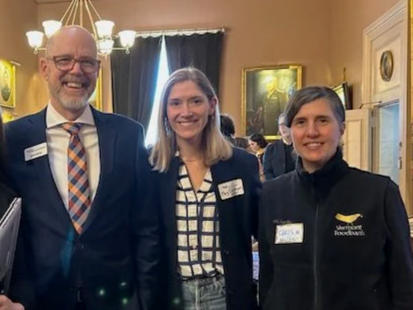
The product is better if the process is inclusive.
This work is rooted in trusting relationships. I joined Vermont Foodbank Executive Director, John Sayles, and Chief Programs Officer, Chris Meehan at the Vermont State House for a SNAP Day of Action.
**the photo is low quality, but I assure you, the impact is high quality.
Planning for food bankers, by food bankers
Between Meredith and me, we've held roles in nearly every department a food bank operates—programs, operations, evaluation, policy, advocacy, fundraising, and executive leadership. This wasn't just helpful context; it was essential.
We understand the incredible operational complexity of serving thousands of people daily. We know the inherent tradeoffs teams face. We've been the frontline staff member who needs to see their daily work reflected in the organizational strategy.
This holistic understanding allowed us to help navigate tensions that would trip up a generalist consultant. We could translate between operations and advocacy, between board governance and warehouse logistics, between aspirational vision and operational reality.
What Strategic Planning Can Be
Strategic planning doesn't have to be a performative exercise that produces a glossy document no one reads. When done with genuine partnership and deep engagement, it becomes a tool for organizational alignment and clarity.
“Meg and Meredith were true partners in this work. They brought deep expertise to every conversation, proactively kept stakeholders informed and engaged throughout the process, and shared insights that made the engagement genuinely valuable. We came in with specific questions we needed answered, and we left having answered every one of them thanks to their expert facilitation.”
The process gave VF three critical things:
Internal alignment: A shared story that helps them say no to good ideas outside their core mission
External clarity: A coherent narrative for funders, partners, and the public
Actionable direction: Not just a roadmap, but a fully completed plan they could implement immediately
The Takeaway: Inclusive Planning Is Worth the Investment
Strategic planning should be inclusive, iterative, and flexible. Building feedback loops at multiple organizational levels adds time and complexity, but it also adds richness, buy-in, and impact.
In uncertain times, organizations don't need consultants who claim to predict the future. They need partners who can help them build clarity together, create alignment across stakeholders, and develop the internal cohesion to navigate whatever comes next.
Ready to bring clarity to your organization's strategic direction?
If your nonprofit is wrestling with too many priorities, unclear focus, or stakeholder misalignment, we'd love to talk. We specialize in strategic planning, annual planning, and facilitation work that brings teams together around shared purpose.